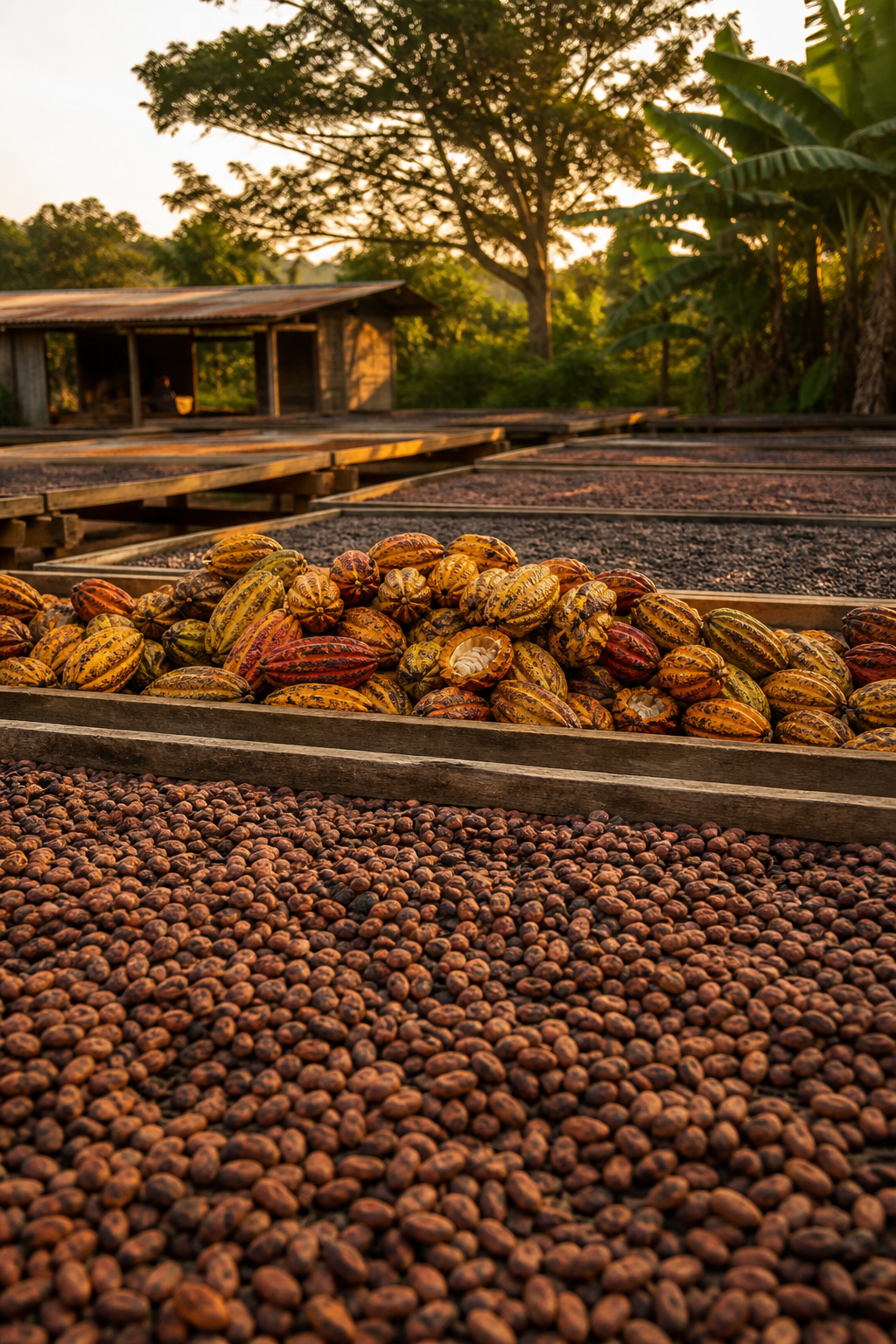
Why post-harvest losses grow
Between harvest and export, a crop passes through stages where value can evaporate: uneven drying, damp storage, repeated handling. Every step without a measurement is a step where the loss goes unnoticed.
Value does not disappear at once: it leaks drop by drop, and no one sees it. Making the loss visible is making it correctable. That is the starting point of any approach.
What actually gets lost
Shifting moisture, breaking beans, mixing grades: these are the three main leaks. They act together and reinforce each other.
A damp batch breaks more in transport, a broken batch mixes more easily. Measuring means untangling these three threads to see where each one pulls.
Measure before you decide
The first action is not to buy equipment, but to weigh at the critical points: intake, drying, warehouse, dispatch. Those numbers reveal where the loss concentrates.
You act on facts, not impressions. The diagnosis orients the action: acting without a diagnosis is shooting in the dark.
Drying, the first lever
Drying decides the moisture, and therefore the preservation and the weight. Controlled drying, tracked per batch, avoids both moldy beans and over-dry beans.
It is the highest-return lever in the chain. A tracked dryer is a mastered dryer: drying time, weather and exit moisture are followed together.
Storage and traceability
A damp warehouse cancels a good drying. Dry, raised, ventilated storage preserves what drying achieved. Loss is decided as much at rest as in transport.
Batch traceability avoids grade mixing and spots a batch that is drifting. It is the condition for the other two levers: without it, you do not know which batch has which problem.
Track a full season
A loss is judged over time. Compare the same volumes, over the same period, before and after the measures. That is how an improvement becomes a number.
A single season proves nothing. The constancy of the measurement, season after season, makes the reliability of the figures and the credibility of the progress.
The pilot site first
A pilot site lets you test without risking the whole. Measure, correct, validate, then reproduce. A method proven on one site rolls out to the others without surprise.
A site that reduces its losses sets the example, the others follow. The snowball effect accelerates the spread of the method.
What you gain
Less loss, more reliable volumes, more consistent quality. And above all, the visibility to act before the port.
Reducing losses is not a cost, it is a return: every tonne saved is a tonne sold. Reduced loss turns into results.
An unmeasured loss is a loss you accept without knowing it.