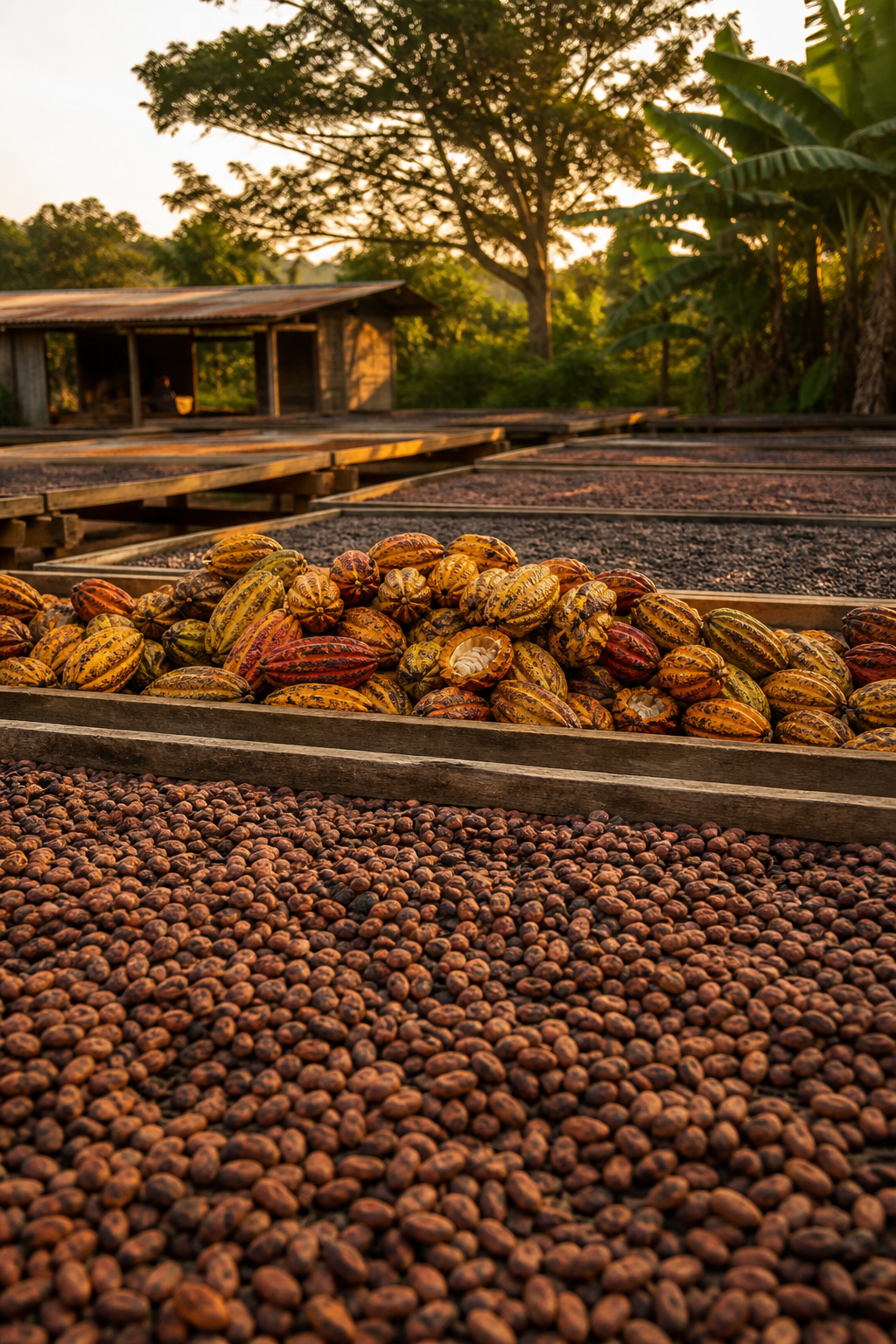
Why moisture rules
A batch that is too wet ferments, molds or gets rejected. A batch that is too dry loses weight, and therefore value. The window between the two is narrow, and it is decided at drying.
Moisture is the reading that decides both preservation and price: that is why it rules the chain.
The acceptable window
For beans, the range sits around 7 to 8 percent. Above it, mold lurks. Below it, weight shrinks and quality degrades during drying.
That window is not a theory: it is the condition for the batch to travel safely. Knowing your buyers' thresholds is knowing where to place the target.
Measure at the right moment
The most useful reading is taken at intake and before shipment. It frames the drying and says whether the batch is ready to travel. One reading in between is not enough.
Moisture shifts with time and climate. The repeated reading, from dryer to port, shows the evolution and the drifts. It is the series that counts.
The right measuring tool
A calibrated moisture meter, used consistently, gives comparable readings. The tool matters less than the regularity: always the same device, always the same method.
A reliable reading beats a precise but irregular one. Regular calibration, with reference samples, guarantees reliability.
Attach the reading to the batch
Every reading must carry the batch number, the date and the place. Otherwise it stays a number without memory, useless in a dispute.
Data only has value when attached to its batch. That attachment turns the reading into proof, and the history into a file.
Drying and transport
Uneven drying gives heterogeneous beans: some too wet, others too dry. Tracking moisture during drying lets you correct before the batch is fixed.
Between the warehouse and the port, moisture can rise or fall. A batch measured at departure must be measured at arrival: the comparison says whether transport protected the product.
The errors to avoid
Measuring once, not noting the batch, changing devices mid-season: three errors that make the history unusable.
The regularity of the method counts as much as the precision of the device. An out-of-threshold reading demands an action: re-dry, ventilate, isolate the batch. Measuring without acting is useless.
What changes on arrival
A batch with documented moisture arrives at the port with proof. The buyer's check confirms your numbers instead of contradicting them.
The dispute over moisture no longer has a hold. Sharing the readings with buyers builds trust: they see that moisture is tracked, not guessed.
Moisture is not guessed. It is measured, then tracked.